


Sometimes, self-care begins with something very simple: a calm breath or holding your own hand.
Those introduced to Jin Shin Jyutsu for the first time often think a treatment is required. This is understandable, but within this Japanese healing art, there is also a tradition of simple self-help exercises. These exercises are intended as a daily moment of rest and mindfulness. They require no special tools and can be performed almost anywhere.
Within Jin Shin Jyutsu, it is assumed that this supports the natural balance of life energy. Modern science does not describe this energy flow as a measurable system. However, it is known that calm breathing and conscious relaxation can contribute to reduced stress and increased body awareness for many people.
Two exercises have formed the basis of self-treatment within Jin Shin Jyutsu for decades.
Exercise 1: The Jin Shin Jyutsu Breath
We breathe all day long. Yet, most people hardly give it a thought. Within Jin Shin Jyutsu, the breath is seen as a way to consciously calm yourself daily. It is not about deep or forced breathing, but about a calm, relaxed breath where you are present with attention.
How to perform the exercise
- Sit or lie down comfortably.
- Gently close your eyes.
- Breathe slowly into your lower abdomen, without forcing it.
- Then, during each exhalation, visualize the energy flowing down from your crown along the front of your body:
- via your face;
- your chest;
- your abdomen;
- your legs;
- down to your toes.
- During each inhalation, imagine the same flow moving back up:
- via the soles of the feet;
- the back of the legs;
- the back;
- the neck;
- back to the crown.
Within Jin Shin Jyutsu, this exercise is traditionally performed in four series of nine breaths, totaling 36 conscious breaths. According to tradition, this symbolizes a new beginning.
What can you expect?
There is no right or wrong experience. Some people feel calmer afterward. Others notice primarily that their thoughts are less hurried. And still others experience little difference. Within Jin Shin Jyutsu, all these experiences are considered normal. The goal is not to “have to feel” something, but to consciously take time for yourself.
Exercise 2: Your Hands as Jumper Cables
Mary Burmeister, who made Jin Shin Jyutsu internationally known, once described the hands as “jumper cables.” With that comparison, she meant that, according to Jin Shin Jyutsu, the hands can play a role in supporting the energy flow in the body. For this exercise, you need nothing but your own hands.
How the exercise works
- Gently wrap one hand around a finger of the other hand.
- Hold the finger for several minutes.
- Within Jin Shin Jyutsu, it is advised to do this until you experience a calm, steady pulsation or simply until it feels pleasant.
- Then, quietly work through all the fingers.
- You can perform the exercise while sitting, lying down, or even during a walk.
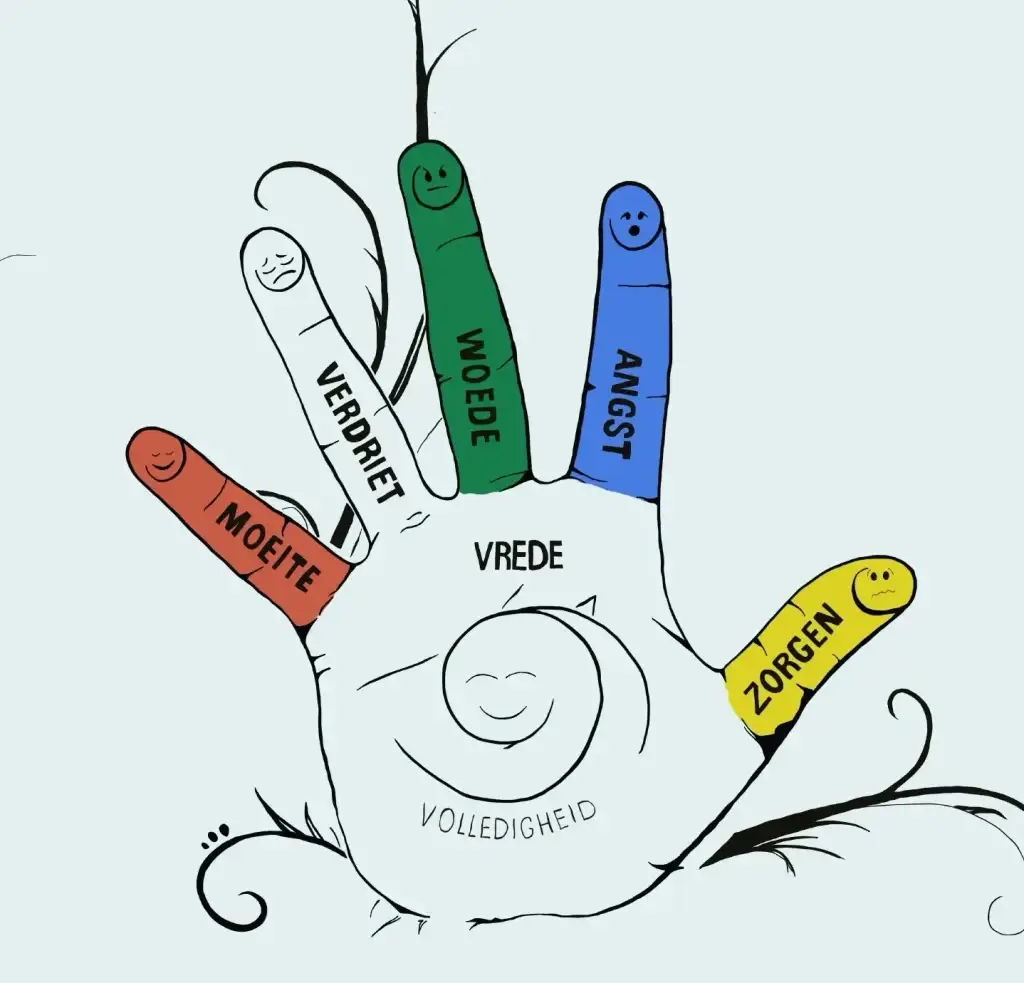
The Meaning of the Fingers within Jin Shin Jyutsu
Within this Japanese tradition, each finger is connected to specific themes. This classification is part of the Jin Shin Jyutsu philosophy and is not based on anatomical or medical research.
The thumb
The thumb is associated with the stomach and spleen. Within Jin Shin Jyutsu, this finger stands for processing: not only of food, but also of thoughts and worries. Many people use this hand hold when they notice they are ruminating.
The index finger
The index finger is connected to the kidneys and bladder. According to Jin Shin Jyutsu, the theme of fear belongs here. The exercise is intended to support trust and inner peace.
The middle finger
The middle finger is linked to the liver and gallbladder. Within the tradition, this finger stands for harmony and dealing with anger or frustration.
The ring finger
The ring finger is associated with the lungs and large intestine. According to Jin Shin Jyutsu, this is related to sadness, breathing, and the rhythm of life.
The pinky finger
The pinky finger is connected to the heart and small intestine. Within the philosophy of Jin Shin Jyutsu, this finger is about intuition, connection, and daring to be yourself.
The center of the palm
The center of the hand also holds special meaning within Jin Shin Jyutsu. This spot is seen as a symbol of harmony and balance for the whole.
Why the hands?
The hands are always available. You don’t have to roll out a mat, put on special clothing, or make an appointment. This makes these exercises easy to incorporate into daily life. During a train journey, at the office, before going to sleep, or simply whenever you need a moment of rest.
Have these exercises been scientifically researched?
Specific research into Jin Shin Jyutsu self-help exercises is still limited. Therefore, no claims can be made about their effectiveness for specific health complaints. However, researchers know that calm breathing, mindfulness, and relaxation can influence stress perception, heart rate, and the sense of well-being. This does not mean that the traditional theory behind life energy has also been scientifically confirmed. That is precisely why it is important to see the exercises as a form of mindfulness and relaxation, not as a replacement for medical treatment.
Small habits can mean a lot
Many people think that health only changes through big decisions. Sometimes, change starts small. A few minutes of conscious breathing, putting your phone away for a moment, gently holding a hand, or simply taking a moment to come back to yourself. Perhaps that is the greatest strength of these exercises. Not that they solve everything, but that they invite you to pause every day.
Next blog in this dossier
The Leonardus Technique – how a youth spent among horses, years of practical experience, and Jin Shin Jyutsu came together in a unique treatment vision.
Disclaimer
These exercises are based on the traditional philosophy of Jin Shin Jyutsu. They are intended as a form of relaxation and self-care and do not replace medical advice, diagnosis, or treatment. In case of persistent or serious complaints, it is important to contact a doctor or other healthcare professional.